

Medically reviewed by Dr Kamaldeep Chawla, MD, DNB (Cardiology), Reg. No. 26154 · Updated [17-11-2026]
People with long-standing chest pain from heart disease often ask whether ESMR could help them. This article covers what ESMR is, how it is thought to work, what published studies have found, its side effects and limits, and the questions worth asking your cardiologist. It is general information and does not replace a consultation.
What Is ESMR?
ESMR stands for Extracorporeal Shockwave Myocardial Revascularization. In medical research, it is usually called cardiac shock wave therapy (CSWT) or extracorporeal shock wave therapy (ESWT) for the heart.
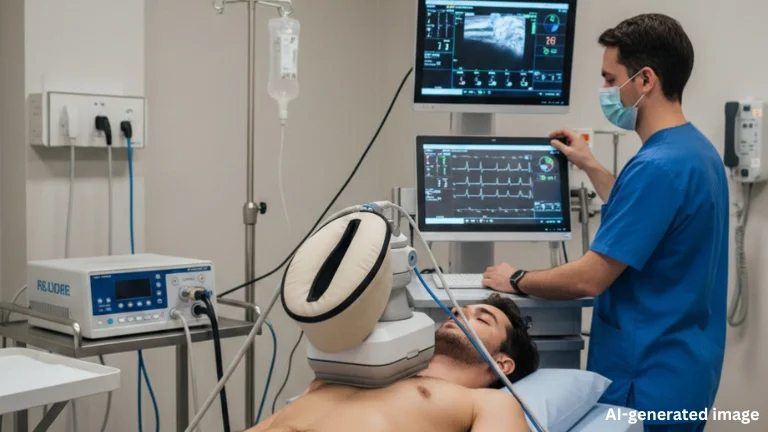
It is a non-invasive procedure. That means there is no cut, no catheter, and no anaesthesia. Low-intensity sound (shock) waves are sent through the chest wall towards areas of heart muscle that are not getting enough blood.
ESMR is considered for selected patients with chronic stable angina: chest pain or breathlessness on exertion that keeps coming back even with medicines. It is generally considered when:
- angioplasty or bypass surgery is not suitable, or
- the patient has already had these procedures and still has symptoms.
ESMR does not remove or open blockages in the coronary arteries, and it is not a treatment for a heart attack or any emergency. You can read more about how the procedure is done at our centre on the ESMR Treatment page.
How Is ESMR Thought to Work?
Before treatment, heart imaging such as an echocardiogram or a perfusion scan is used to find the areas of heart muscle with reduced blood supply. During each session, the shock waves are focused on those areas, timed with your heartbeat using ECG monitoring.
Laboratory and animal studies suggest the waves may trigger the release of growth factors. These may encourage new small blood vessels to form (angiogenesis) and improve blood flow in the targeted area. This mechanism is still being studied. It has not been fully confirmed in humans.
Possible Benefits
Studies have reported improvements in some patients in:
- how often angina episodes happen and how severe they are
- the need for short-acting nitrate tablets (such as sublingual nitroglycerin)
- how far or how long a person can walk or exercise before symptoms start
- quality-of-life scores
These are possible outcomes, not guaranteed ones. Some patients notice a clear change, some notice a small change, and some notice none. Any benefit usually develops gradually over weeks to months, not immediately.
What Does the Research Say?
The largest summary of the evidence so far is a systematic review and meta-analysis by Burneikaitė and colleagues, published in Cardiovascular Ultrasound in 2017.
- It looked at 39 studies involving 1,189 patients with stable angina, of whom 1,006 received shock wave therapy.
- Across the studies, patients reported improvement in angina symptoms or quality of life.
- In the 12 controlled studies (483 patients), treated patients improved in:
- angina class (CCS)
- Seattle Angina Questionnaire scores
- nitrate use
- In the 22 studies (593 patients) that measured exercise capacity, there was a moderate improvement.
The same review also points out important limits:
- Most studies were small and done at a single centre.
- Treatment protocols, patient selection and follow-up periods varied between studies.
- Many studies did not have a control group or blinding.
- The authors concluded that larger, well-designed randomised trials are needed.
The research so far has mainly measured symptoms, exercise capacity and quality of life. There isn’t strong evidence yet that ESMR reduces the risk of heart attack or improves survival. That is why it is used alongside medicines and lifestyle changes, not in place of them.
Possible Side Effects
ESMR is generally well tolerated in published studies. Most people do not need pain relief during sessions. Some side effects have been reported:
- a tapping or tingling sensation in the chest during treatment
- tiredness after a session
- mild redness or discomfort of the skin where the applicator is placed
These usually settle on their own. Tell the treating team right away if you get chest pain, breathlessness, palpitations or dizziness during or after a session. Your heart rhythm and vital signs are monitored throughout treatment.
Who Should Not Have ESMR?
ESMR may not be suitable if you have:
- pregnancy
- a recent heart attack or unstable angina (new chest pain, worsening or occurring at rest)
- an active infection
- other conditions your cardiologist will check for during assessment
Not everyone with angina is a candidate. Suitability is decided after a consultation and tests.
Limitations to Know Before You Decide
- It does not clear blockages. If a blockage needs opening, angioplasty or bypass surgery may still be advised.
- Results vary. Some patients see little or no change in symptoms.
- It takes time. A full course runs over several weeks, and any improvement is gradual.
- Medicines continue. ESMR does not replace your prescribed heart medicines. Do not stop or change them without your cardiologist’s advice.
- Evidence is still developing. Larger trials are needed to confirm how well it works and for whom.
The NHS also has patient guides on coronary angioplasty and coronary artery bypass graft.
What Does an ESMR Course Involve?
- Consultation and assessment. The cardiologist reviews your history, medicines, and previous procedures.
- Heart tests. These may include ECG, echocardiography, a stress test or a perfusion scan, depending on what you have already had. Our cardiology services page explains these tests.
- Treatment sessions. A typical course is about 9 sessions spread over around 9 weeks. Each session lasts about [30–40] minutes. You lie on your back while the applicator is placed on your chest.
- Follow-up. Your symptoms, medicines, and test results are reviewed during and after the course.You can usually go home after each session and carry on with routine daily activities, unless your doctor advises otherwise.
Cost of ESMR at Ayushman
The fee for a full ESMR course at Ayushman Heart & Wellness Center is ₹[ ] for [ ] sessions. This includes [assessment/imaging/follow-up — specify]. Any additional tests advised are charged separately. Please ask for a written estimate at your consultation.
Insurance coverage for ESMR varies by policy. Check with your insurer before starting.
Questions to Ask Your Cardiologist
- Is my angina likely to improve with ESMR, given my test results?
- Would angioplasty or bypass surgery be a better option for me?
- Which tests do I need before starting?
- How will we measure whether the treatment is helping?
- Do I need to change any medicines during the course?
- What should I do if my symptoms get worse?
Frequently Asked Questions
Is ESMR painful?
Most people do not need anaesthesia or pain relief. Some feel a tapping or tingling sensation in the chest during the session.
Does ESMR remove blockages?
No. ESMR does not open or remove blockages. It is thought to improve blood flow to affected heart muscle by encouraging small new blood vessels.
Can ESMR replace angioplasty or bypass surgery?
Not in general. It is considered for selected patients in whom these procedures are not suitable, or who still have symptoms after them. Your cardiologist will advise what fits your condition.
When might I notice a change?
It varies. In studies, changes in symptoms were usually assessed over weeks to months after the course. Some patients notice little or no change.
Can I stop my heart medicines after ESMR?
No. Continue your medicines as prescribed and discuss any change with your cardiologist.
Is ESMR used in emergencies?
No. If you have sudden, severe, or prolonged chest pain, call 108 or go to the nearest emergency department immediately.
Talk to a Cardiologist in Vadodara
If you have chest pain or breathlessness that continues despite treatment, a cardiologist can assess your options. This may or may not include ESMR. Learn about our cardiologists in Vadodara or call +916355119267 to book a consultation.
Disclaimer: This article is for general information and education only. It is not medical advice and does not replace a consultation with a qualified doctor. Treatment decisions depend on individual assessment, and results vary from person to person.
Sources
- Burneikaitė G, Shkolnik E, Čelutkienė J, et al. Cardiac shock-wave therapy in the treatment of coronary artery disease: systematic review and meta-analysis. Cardiovascular Ultrasound. 2017. Read on DOAJ
- NHS. Coronary angioplasty and stent insertion. nhs.uk
- NHS. Coronary artery bypass graft. nhs.uk
