

ESMR Treatment – Non-Invasive Heart Care
ESMR (Extracorporeal Shockwave Myocardial Revascularization) is a non-invasive treatment offered at Ayushman Heart & Wellness Center for selected patients with chronic angina. Your cardiologist may consider it if you still have chest pain despite medicines and angioplasty, or if bypass surgery is not suitable for you, or if you have already had those procedures. ESMR is used alongside your regular heart medicines; it does not replace them.
What is ESMR Therapy?
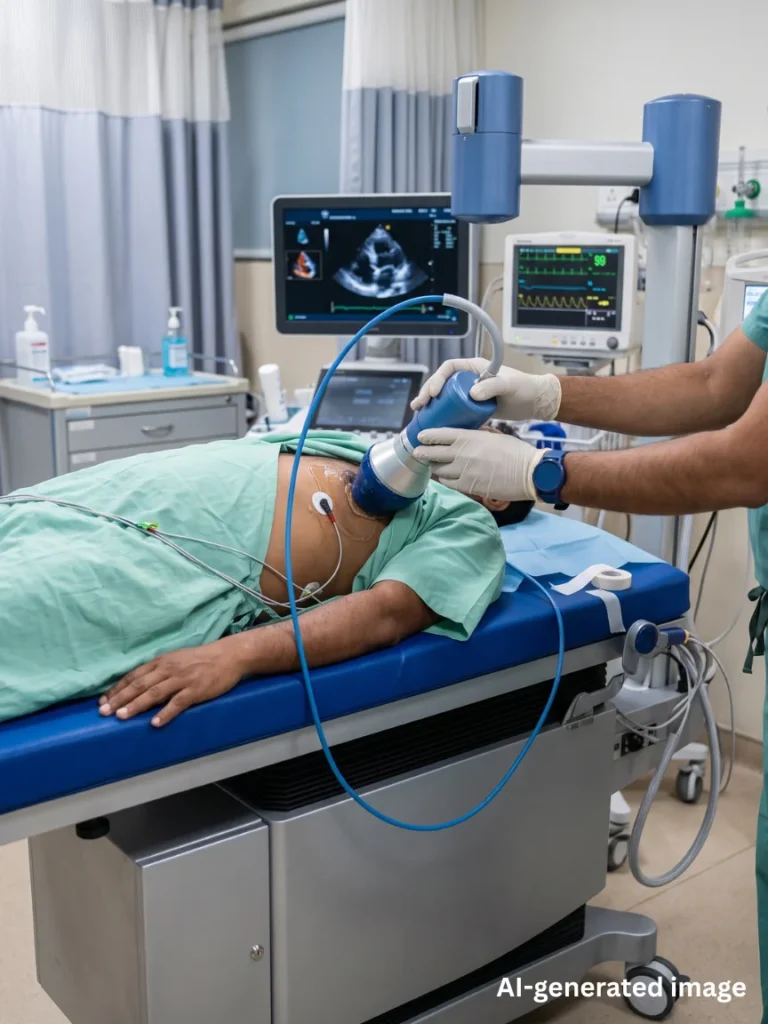
ESMR uses low-intensity shockwaves, delivered from outside the chest, to target areas of the heart muscle that have reduced blood flow. Before each session, an ultrasound scan of the heart is used to locate these areas. The shockwaves are timed to your heartbeat using ECG monitoring.
The shockwaves are thought to encourage angiogenesis, the growth of small new blood vessels in the treated area. Some studies report that this may improve blood supply to the heart muscle and reduce angina in some patients. Results vary from person to person. ESMR does not remove existing blockages.
No surgery, catheter, stent or anaesthesia is involved. Most patients go home after each session and can continue their usual daily activities. Some feel a tingling sensation or mild discomfort during the session. Your cardiologist will explain whether ESMR is appropriate for you, what to expect, and any risks specific to your condition.
Who May Be Considered for ESMR Treatment?
Your cardiologist decides whether ESMR is suitable after reviewing your symptoms, heart tests, and medical history. It may be considered for:
- Chest pain that continues despite medicines: Patients whose chronic angina persists even on regular heart medicines.
- Patients for whom angioplasty or bypass is not suitable: For example, when the artery anatomy does not allow a stent or surgery, or when conditions such as diabetes, kidney disease, or advanced age make surgery high-risk.
- Angina after earlier procedures: Patients who still have angina after a previous angioplasty or bypass surgery.
- Reduced blood flow confirmed on tests: Patients whose tests show areas of the heart muscle with reduced blood flow that can be targeted with treatment.
ESMR does not replace angioplasty or bypass surgery when your cardiologist recommends them. It is not an emergency treatment.
Who Should Not Have ESMR?
ESMR may not be suitable if you:
- are pregnant
- have had a recent heart attack
- have an active infection
Your cardiologist will check these and any other conditions before advising treatment.
Possible Benefits of ESMR Treatment
Studies of ESMR have reported the following benefits in some patients. Results vary from person to person, and your cardiologist will discuss what you can realistically expect.
How ESMR Treatment Works
Before treatment
Your cardiologist reviews your symptoms, medicines and heart test reports to decide whether ESMR is suitable for you. If it is, the treatment plan, number of sessions, fees and possible side effects are explained to you before you start.
During each session
You lie on a treatment bed while an ultrasound scan of the heart locates the areas with reduced blood flow. Low-intensity shockwaves are then delivered to these areas from outside the chest, timed to your heartbeat using ECG monitoring. Each session takes about 30–40 minutes. No anaesthesia, incision or catheter is needed. Some patients feel a tingling sensation or mild discomfort during the session.
Course of treatment
A standard course is 9 sessions over about 9 weeks. Your cardiologist may adjust the schedule based on your condition.
After each session
Most patients go home the same day and continue their usual activities. Keep taking your regular heart medicines unless your doctor advises otherwise. Your cardiologist will review your symptoms and tests during and after the course to assess your response.
What’s Included in Your ESMR Course

Visit us at
AYUSHMAN HEART
& WELLNESS CENTER
Open Monday to Saturday, 8 am to 8 pm. You can book a consultation, heart test, or health checkup by phone or through this form. Our team will call you to confirm the date and time.
Service Recipient Says


Oxmox advised her not to do so, because there were thousands of bad Commas, wild Question Marks and devious.
Kolis Muller NY Citizen
Oxmox advised her not to do so, because there were thousands of bad Commas, wild Question Marks and devious.
Kolis Muller NY Citizen


Oxmox advised her not to do so, because there were thousands of bad Commas, wild Question Marks and devious.
Kolis Muller NY Citizen