

Medically reviewed by Dr Kamaldeep Chawla, MD, DNB (Cardiology), Reg. No. 26154 · Updated – [24/10/2026]
If you have coronary artery disease and ongoing chest pain (angina), your cardiologist may discuss several treatment options with you. These include medicines, angioplasty with a stent, coronary artery bypass surgery, and, for some patients, ESMR. This guide explains how bypass surgery and ESMR differ, so you can have a more informed conversation with your doctor.
These two treatments are not interchangeable. They work in different ways and are used for different situations. The right choice depends on your heart reports, your symptoms and your overall health, and only your cardiologist can make that assessment.
What Is Coronary Artery Bypass Surgery?
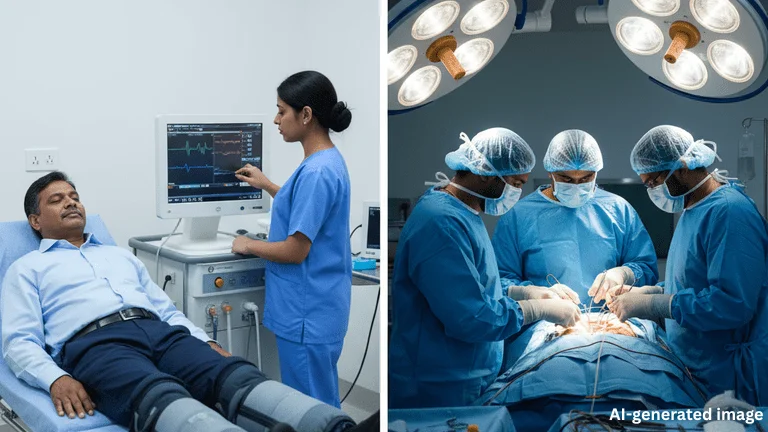
Coronary artery bypass graft (CABG) surgery is an operation to improve blood flow to the heart. A surgeon takes a healthy blood vessel from another part of the body, usually the chest, leg or arm. They use it to create a new route for blood to flow around a narrowed or blocked coronary artery.
- It is done under general anaesthesia, usually through an incision in the chest.
- Most people stay in hospital for about a week.
- Full recovery usually takes 2 to 3 months (NHS).
- Like any major surgery, it carries risks, which your surgeon will explain in detail (NHS: complications of CABG).
Bypass surgery is a well-established treatment. It is often recommended when several arteries are severely narrowed, or when the main artery on the left side of the heart is affected.
What Is Angioplasty?
Coronary angioplasty is another common option. A thin tube (catheter) is passed through a blood vessel to the narrowed artery, a small balloon widens it, and a stent is usually placed to keep it open. Many people go home the same day or the next day (NHS). Your cardiologist will advise whether angioplasty or bypass suits your artery pattern.
What Is ESMR?
ESMR (Extracorporeal Shockwave Myocardial Revascularization), also called cardiac shockwave therapy, is a non-invasive treatment. Low-intensity shockwaves are delivered from outside the chest to areas of the heart muscle with reduced blood flow. The shockwaves are thought to encourage the growth of small new blood vessels in the treated area.
- No incision, catheter, or anaesthesia is needed.
- A typical course is 9 sessions over about 9 weeks, each lasting around 30–40 minutes.
- Most patients go home after each session.
ESMR does not remove or bypass blockages. It is generally considered for selected patients with chronic angina who still have symptoms despite medicines, when angioplasty or bypass is not suitable or has already been done. Read more on our ESMR treatment page.
Key Differences at a Glance
| Bypass Surgery (CABG) | ESMR | |
| What it does | Creates a new route for blood around blocked arteries | Aims to improve blood supply to heart muscle by encouraging small new vessels |
| Does it treat the blockage? | Yes, by bypassing it | No |
| How it is done | Open surgery under general anaesthesia | Shockwaves from outside the chest, no anaesthesia |
| Hospital stay | About a week | None; outpatient sessions |
| Recovery | Usually 2–3 months | Usual activities generally continue between sessions |
| Typically used for | Severe or multiple blockages suitable for surgery | Chronic angina when angioplasty or bypass is not suitable or has already been done |
| Evidence | Long-established, with large studies over decades | Mostly smaller studies; larger trials still needed |
| Emergency use | Can be part of urgent heart care | Not an emergency treatment |
What the Research Says About ESMR
A 2017 systematic review looked at 39 studies covering 1,189 patients with stable angina. All the studies reported improvement in angina symptoms or quality of life, and the controlled studies showed improvements in angina class and reduced use of nitrate medicines. However, the reviewers noted that most studies were small and done at a single centre. They called for larger randomised trials to confirm the results (Burneikaitė et al., Cardiovascular Ultrasound, 2017).
In simple terms, ESMR may help reduce angina in some patients. It is not a replacement for bypass surgery when surgery is recommended, and results vary from person to person.
Possible Side Effects and Limitations of ESMR
- Some patients feel tingling or mild discomfort during a session, or temporary tiredness afterwards.
- It may not be suitable during pregnancy, after a recent heart attack, or with an active infection. Your cardiologist will check for other conditions too.
- It does not remove blockages, and it does not replace medicines, angioplasty or bypass surgery when these are advised.
- Not every patient improves, and any change is usually assessed after the full course.
How Is the Right Treatment Decided?
Your cardiologist will usually consider:
- Your symptoms and how much they affect daily life
- Results of tests such as ECG, echocardiogram, treadmill test and coronary angiography (see our heart tests page)
- The number, location and severity of blockages
- Your age, kidney function, diabetes and other health conditions
- Your preferences, after the benefits and risks of each option have been explained
Some patients may be advised to have bypass surgery or angioplasty. Others may be managed with medicines. A smaller group with ongoing angina may be considered for ESMR. Please do not choose or avoid a treatment based on an article alone.
Questions to Ask Your Cardiologist
- Which arteries are affected, and how severe are the blockages?
- Am I suitable for angioplasty or bypass surgery? If not, why?
- What are the expected benefits and risks of each option for me?
- If ESMR is suggested, what results can I realistically expect, and how will they be measured?
- What happens if I choose not to have a procedure?
Frequently Asked Questions
Can ESMR replace bypass surgery?
No. ESMR does not bypass or remove blockages. It is considered for selected patients with ongoing angina, often when bypass or angioplasty is not suitable or has already been done.
Is ESMR safe?
Studies have reported few serious side effects, but some patients feel discomfort or tiredness, and ESMR is not suitable for everyone. Your cardiologist will check whether it is appropriate for you.
How much does ESMR cost at Ayushman?
The fee for a full ESMR course at Ayushman Heart & Wellness Center is ₹[amount]. Your cardiologist will confirm the fee and number of sessions before treatment starts.
I have sudden, severe chest pain. Should I consider ESMR?
No. Sudden or severe chest pain may be a heart attack. Go to the nearest emergency department immediately.
This article is for general information and does not replace advice from your doctor. To discuss your treatment options, you can consult a cardiologist in Vadodara at Ayushman Heart & Wellness Center.
Sources
- NHS – Coronary artery bypass graft, Recovery, Complications
- NHS – Coronary angioplasty and stent insertion
- Burneikaitė G, et al. Cardiac shock-wave therapy in the treatment of coronary artery disease: systematic review and meta-analysis. Cardiovascular Ultrasound, 2017.
